
Why Millennial Oldest Daughters❤️ "Waitress"

They really, really do!
I have yet to meet a millennial woman who hates the film and/or the Broadway play Waitress. (If you are that woman, then this post is not for you. You may find my journal prompts to be a more entertaining fare.)

I often wondered why. Time, life, and listening to the play soundtrack, particularly the song “She Used to Be Mine,” finally gave me the answer.
“Waitress” was our reality, or a foreshadowing of it
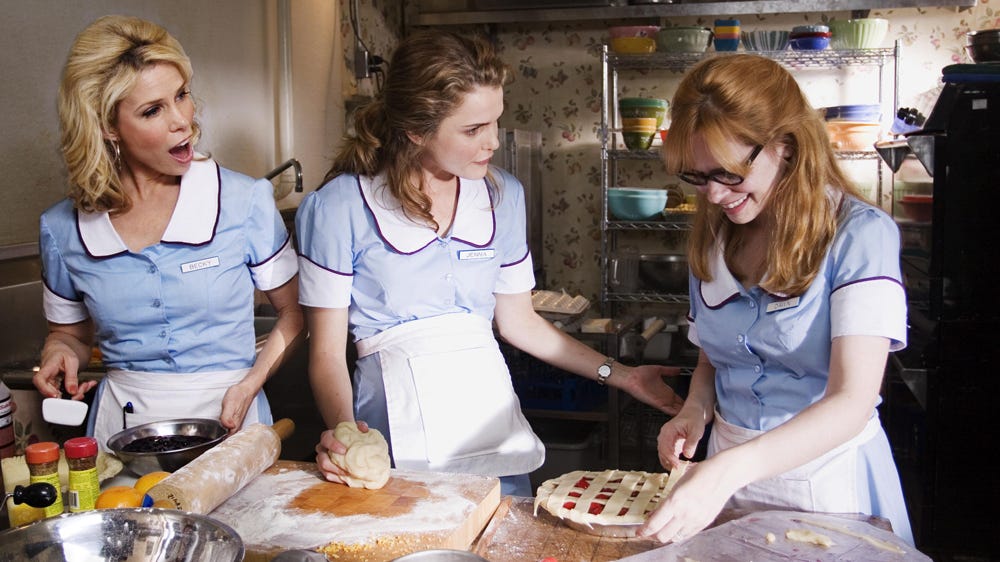
The story was our reality when it was released, with an ending that many of us are living or working toward right now. Jenna, the main character in the movie, was played by Keri Russell, someone I most recently enjoyed in the Netflix series The Diplomat. Jenna, like so many of us in 2007, had the life we millennial women were told to seek out. She was married and owned a home with her husband, Earl (Jeremy Sisto), who held down a steady job.
Waitress, the movie came out in 2007, about six years after the events of 9/11/2001 changed life as we knew it here in the US. It came after most elder millennial women had already gotten a peek at the dumpster fire of a future to come. I’m talking about today’s housing prices that are way too high, wages that are way too low, healthcare is a joke, and a water shortage on the horizon.
Putting the Boomers on blast
The movie even depicted the Boomer generation that created the mess, who were already gaslighting us about it. Old Joe, played by the late Andie Griffith, had THE NERVE to criticize Jenna on her life failures—things that his generation was responsible for!
Those interactions were a representation of the boomer rants about lattes and avocado toast being the reason we couldn’t afford to own a home. That made a joke of the millennial generation.
In reality, we were living the future that our parents and grandparents thought they would be too dead to be held accountable for.
Goodbye Earl!
Many of us caught the fact that Jenna’s Earl was the namesake of the man who was unalived in the 1999 song by The Chicks. “Earl” was the song we all belted out with our girlfriends after every breakup.
Jenna’s Earl was just as bad. Selfish, manipulative, incompetent, but always throwing the family’s future away on some stupidity. Jenna’s Earl liked to beat women, too.
But he was a good man, Savannah...um, I mean Jenna, or so everyone in town said. That’s because he didn’t cheat and brought his paycheck home. If I had a dollar for every time I heard this after my divorce, I would be on an island somewhere still on vacation. That’s how deep the sentiment runs.
The reality that we felt, but no one wanted to talk about
Firstborn daughters, like myself, were drowned in the doctrine of finding a good man, buying a home, and raising some kids. But the economy in 2007 was already showing younger millennials (who were about 17 at the time) that such a thing was NOT possible. The math wasn’t even close to mathing.
I was in the thick of it, like many elder millennials, seeing firsthand that none of it added up to a life satisfactory to anyone except the Earls of our generation. My ex-husband was having the time of his life. However, I was trying to figure out what the fuck was wrong with the life I was living. I was doing everything that I was told at the time. Why was the American Dream so far out of reach?
The younger sisters of our generation would bear the burden of this. The world would be too far gone to deny the reality by the time they were 27. All the same, we were the last generation of daughters raised to be mothers and wives in a world where women needed to be so much more, to do so much less, with much, much less than our fore-mothers had. We did have the freedom our ancestors longed for, but not the money or support to do much with it.
We were all maturing into womanhood, and finding out that the life we were trained, groomed, and conditioned to live did not exist. We had dreams. We longed for true love. But we were left sitting squarely at the threshold of the fall of capitalism and white supremacy. (It entrapped white women, too, by the way, but few saw it—go over and subscribe to the blog of Wolf Terry here on Substack. She breaks it down on the regular.)
Jenna was all of us, slumbering through life, while the Earls enjoyed our bodies
We elder millennials were already up to our necks with slumbering lives like Jennas, then, complete with our own “Earls.” (I finally broke free of mine after 24 years. Some did it sooner. Others are still asleep.) Our little generational sisters could already see that their Prince Charmings were more like Lord Farquads. We all just had a feeling deep within that there MUST be something more out there.
Then, Jenna’s story came out, and I was never the same. She spoke in monotone to match her monotonous life. Her job sucked, and her life was a never-ending, boring cycle, with the occasional fight and one-sided humping performance by Earl.
Then, one night after drinking before Earl’s performance, therefore forgetting her protection, Jenna got pregnant. That is what shook her from the life she was sleeping through. Just like the movie woke us up from our slumber through the lie that was the American Dream.
The movie still holds meaning for us almost 20 years later
There is so much more to this movie than I can add here. And honestly, I want to wait until next year’s anniversary to do a thorough breakdown.
The appeal of the film, however, was Jenna. Her unspoken thoughts, narrated by Russell, were things we had all said or could see ourselves saying. Her life, her mannerisms, her thoughts all hit a spot where we were all stuck, at a time when safety, stability, and love were out of balance in the world.
The beginning of the film, where we see Jenna sleepwalking through a terrible life, was us! The end, where she is living a life of her own creation—making pies all day in her own shop—is where we all wanted to end up.
For many of us, that’s the life we are trying to build right now, nearly two decades later, divorcees, empty-nesters, perimenopausal, too. Finally, looking to create our own “pie shop” in life.
I want to add here that I now want so badly the weird relationship that Dawn (Adrienne Shelley) had with her (obviously neurospicy) insurance man, Ogie (Eddie Jemison).
Again, there is so much more I could write about this film, but I’ll save it for the 20th-anniversary essay. More on that later.
“She’s gone, but she used to be mine.”
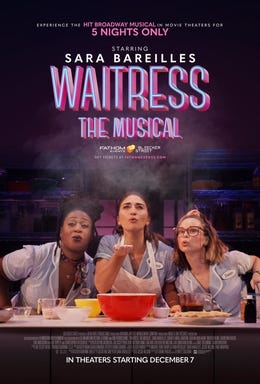
I do want to recommend a song to anyone who connects to this post. If it sounds like you, please go to your music streaming platform and find Sara Bareilles’s “She Used to Be Mine.” It comes from the musical and is the first song that Bareilles wrote when tasked with the soundtrack. The song sums up the character of Jenna and the awakening that the character had. The chorus is what does it for me:
She’s imperfect, but she tries
She is good, but she lies
She is hard on herself.
She is broken and won’t ask for help
She is messy, but she’s kind
She is lonely most of the time
She is all of this mixed up
And baked in a beautiful pie
She is gone, but she used to be mine
That verse describes the woman I used to be before my divorce and semi-cross-country move. That verse was the woman that Jenna was before HER divorce and definitely after she cut off the philandering Dr. Pomatter (Nathan Fillion).
I love that the song encourages us to recognize and be honest about who we were, but to never forget her. Instead, Jenna claims her, sits her down for a talk, and then tucks her into bed for a much-needed rest while Jenna takes the wheel of her life for once.
I had to sit my inner self down for a chat, through journaling
I did the same through journaling. I sat down with that girl who thought she was doing the right thing and the young mother who thought she was living life the way everyone told her to. I let them grieve, weep at the unfairness, and gush over the babies we made and the moments that they gave us along the way. Then, I told her to take a seat, and I got the wheel. I am taking over my life, and we started on a wild adventure.
She is gone, no longer at the wheel, but I claim everything she did, nor regrets.
“She’s gone, but she used to be mine.”
Go stream Waitress on any platform. I think everyone has it by now. Cue up Sara Bareilles afterward with a glass of wine. If you want to, check out my journal prompts to begin that long talk with the woman you used to be. If it helps, start by having a conversation –with her—about Jenna.
Until next time, keep it classy.
Jo